
Hiroshima Castle
広島城
Hiroshima Castle, a 16th-century fortress, is worth visiting for its history and museum.
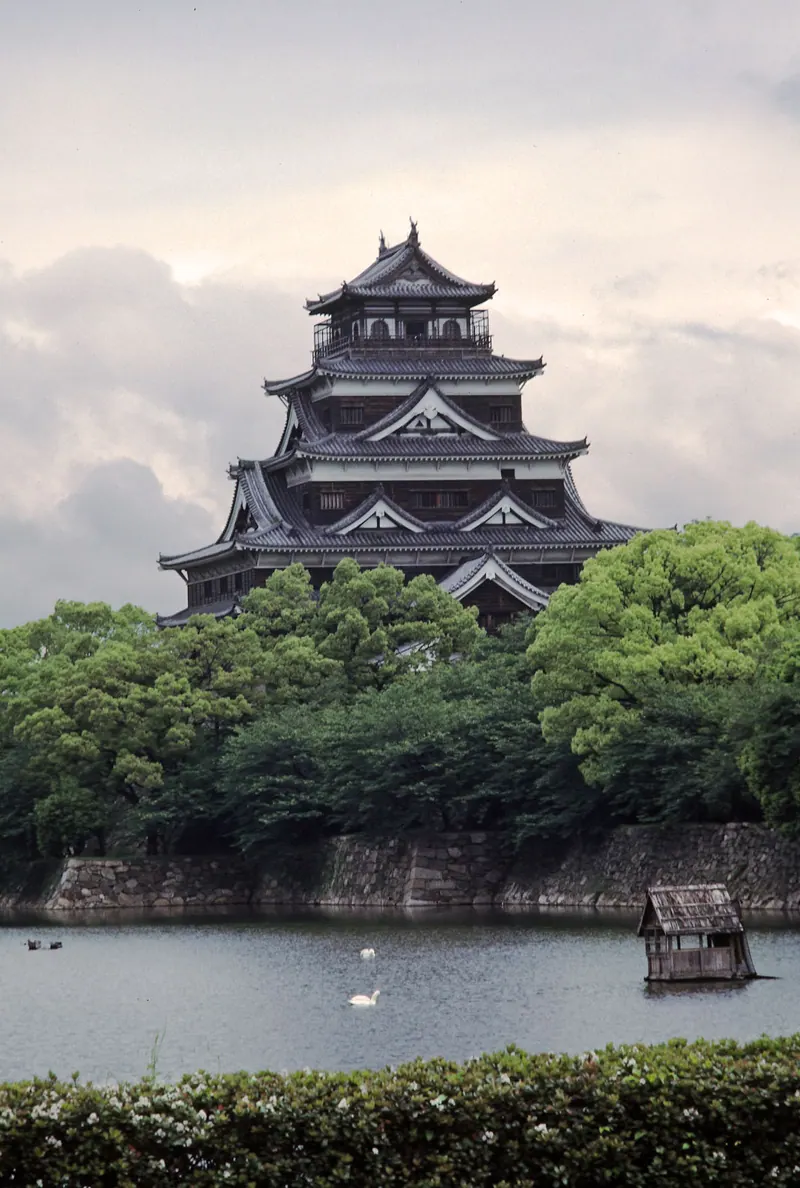
What it is
- Castle founded in the late sixteenth century.
- Established by warlord Mohri Terumoto.
- Nicknamed "Carp Castle."
- Now houses a museum of pre-Meiji era history.
What to see
- Formidable stone walls.
- Keep and one remaining triple moat.
- Imposing tower, a 1958 concrete reconstruction.
- Museum with artifacts from Hiroshima's history.
- Three trees that survived the atomic bombing.
In detail
Hiroshima Castle has a history that stretches back to the late sixteenth century. The catalyst for the eventual growth of Hiroshima into a city, the fortress was established by the powerful warlord Mohri Terumoto (1553–1625), who at that time ruled over the majority of the region. Flat land in the Ota River delta was chosen as the site for the castle’s construction, being both relatively easy to build on and to defend.
Hiroshima Castle, with its formidable stone walls, keep, and triple moats (only one of which remains), was built between 1589 and 1599. It was crowned with an imposing tower and accompanied by the establishment of a castle town. Terumoto occupied this stronghold from 1591, as he presided over nine provinces that today comprise Hiroshima, Shimane, and Yamaguchi Prefectures and also parts of Okayama and Tottori Prefectures. The fortress came to be nicknamed “Carp Castle.”
Following the Battle of Sekigahara in 1600, which was key to the unification of Japan under the Tokugawa shogunate until 1867, Terumoto was forced to abandon the castle he had established. Fukushima Masanori (1561–1624) subsequently occupied Hiroshima Castle as the daimyo lord of Aki and Bingo Provinces, until he was banished for repairing damage caused to the castle by a flood in 1619 without first gaining permission from the shogunate. Twelve generations of the Asano family then governed from the castle, until the end of Tokugawa rule and the abolishment of feudalism. Hiroshima Castle then became a facility for the Japanese Imperial Army. In 1931, the original main tower was designated a National Treasure.
Toward the end of World War II, troops were stationed here in anticipation of an Allied invasion. On August 6, 1945 the castle was leveled by the atomic bombing; research suggests its lower pillars were destroyed by the blast, causing the rest of the structure to collapse. The present-day Hiroshima Castle tower, now housing a museum that displays mainly artifacts from Hiroshima’s pre–Meiji era (1868–1912) history, is a concrete reconstruction of the wooden original, and was completed in 1958. Still present within the castle walls, however, are three trees that survived the atomic bombing.
Text: 観光庁 地域観光資源の多言語解説文データベース. Reproduced unchanged. The notes above were written from that text by Japan Gems.
Where it is
広島県広島市中区基町21-1 Open in Google Maps
この施設の関係者の方へ
このページは公開情報をもとに Japan Gems が作成し、訪日外国人向けに英語で掲載しています。 写真や情報の追加・修正を承っています。お店の写真に差し替えることもできます。
このページの情報を更新する