
Hiroshima Peace Memorial Park
平和記念公園
A tranquil park in Hiroshima, it memorializes lives lost in the first nuclear attack and reaffirms life.
What it is
- Park memorializing lives lost in the world's first nuclear attack.
- Created in 1949 as a place of remembrance and contemplation.
- Covers over 120,000 square meters, like a green island.
What to see
- A-bomb Dome, located at the north end of the park.
- Peace Memorial Museum, designed by Tange Kenzo.
- Statues dedicated to mobilized students and Korean citizens.
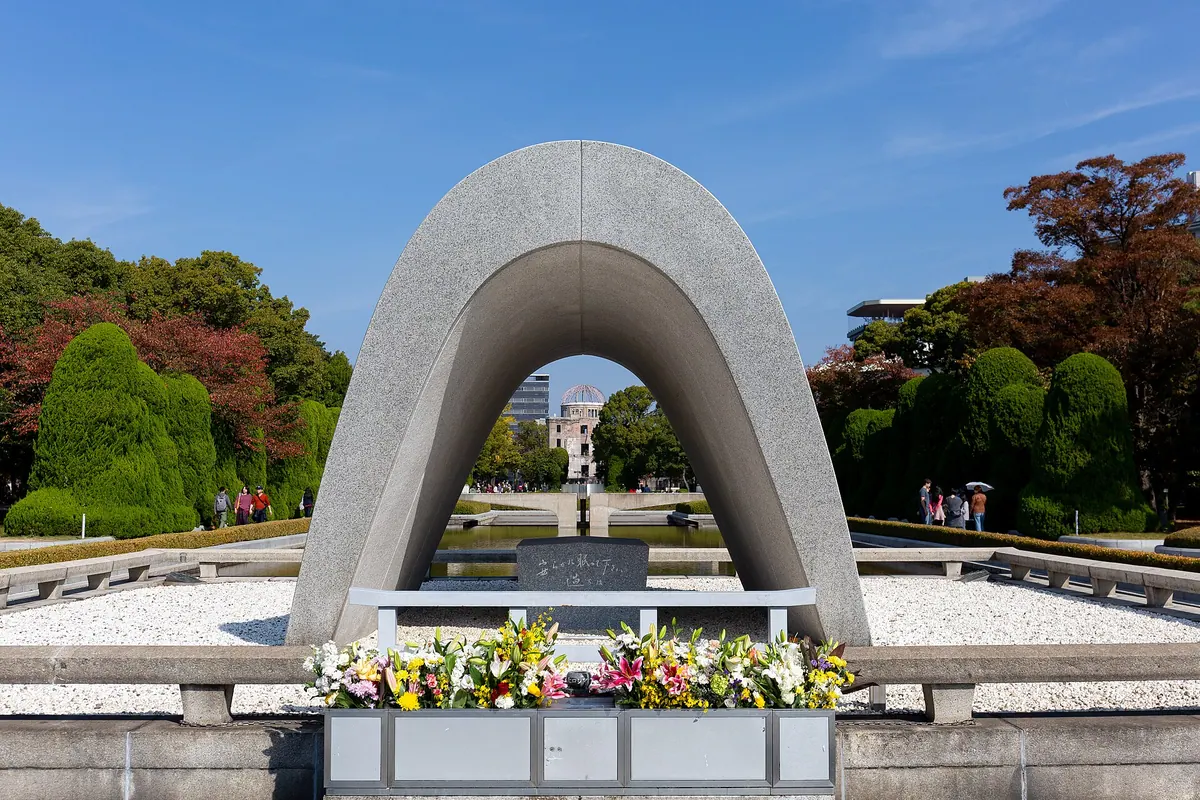
- Cenotaph for the A-bomb Victims, a concrete structure.
- Cenotaph inspired by an ancient clay figurine (haniwa).
Getting there
- Located mostly on a narrow stretch of land between two rivers.
- Bridge takes visitors over from the east bank of the Motoyasu River.
In detail
Hiroshima Peace Memorial Park, extending southwards from the A-bomb Dome and located mostly on a narrow stretch of land between two rivers, feels somewhat like a green island in the middle of the city. A tranquil spot covering over 120,000 square meters, it serves to memorialize the great many lives lost in the world’s first nuclear attack, while making use of nature to reaffirm the preciousness of all life.
Just south of the A-bomb Dome along the east bank of the Motoyasu River, a bridge takes visitors over to the slice of land on which the majority of the park is situated. Prior to the 1945 bombing, this district was the administrative and commercial heart of Hiroshima. In 1949, the recovering city decided the area should become a place of remembrance and contemplation, rather than simply being rebuilt.
A number of monuments have been constructed in the park over the decades since it was created. These range in scale from the expansive Peace Memorial Museum, designed by renowned architect Tange Kenzo (1913–2005), to modestly-sized statues dedicated to mobilized students, Korean citizens who were killed or injured, and several notable individuals.
Each of these memorials, all within easy walking distance of each other, possesses its own particular poignancy. For many visitors, the most striking is the Cenotaph for the A-bomb Victims. Another Tange design, this concrete structure built in 1952 was inspired by an ancient clay figurine (haniwa), and as such is intended to offer shelter for the souls of the deceased.
Text: 観光庁 地域観光資源の多言語解説文データベース. Reproduced unchanged. The notes above were written from that text by Japan Gems.
Where it is
Hiroshima Peace Memorial Park Open in Google Maps
この施設の関係者の方へ
このページは公開情報をもとに Japan Gems が作成し、訪日外国人向けに英語で掲載しています。 写真や情報の追加・修正を承っています。お店の写真に差し替えることもできます。
このページの情報を更新する