
Kumamoto Prefectural Museum of Art
English 繁體中文
熊本県立美術館
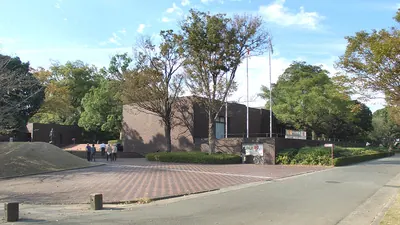
This museum, designed by Maekawa Kunio, offers ancient and modern art, including a unique kofun display.
What it is
- Art museum designed by architect Maekawa Kunio.
- Considered one of Maekawa’s masterpieces.
- Houses ancient, modern Japanese, and Western art.
- Features collections linked to Kumamoto and the Hosokawa family.
What to see
- Low-rise building designed by Maekawa Kunio.
- Imanishi Collection: ukiyo-e prints, tea utensils, objets d’art.
- Hamada Chimei Display Room: works by Kumamoto-born artist.
- Permanent display of painted kofun (megalithic tombs).
- Hosokawa Family Collection: paintings, Noh masks, armor.
- Café and terrace overlooking Kumamoto Castle grounds.
When to go
- Exhibitions change regularly throughout the year.
Getting there
- Located in the northwest corner of Kumamoto Castle grounds.
In detail
This museum is located in the northwest corner of the Kumamoto Castle grounds. The building was designed by distinguished architect Maekawa Kunio (1905–1986), a student of Le Corbusier, who also designed the Tokyo Metropolitan Art Museum in Ueno, Tokyo. This low-rise structure, which merges with the natural scenery around it, is considered one of Maekawa’s masterpieces.
The museum’s collections span three broad categories: ancient Japanese art connected with Kumamoto; Japanese modern art, often by artists with links to Kumamoto; and Western art. The Imanishi Collection includes ukiyo-e prints, tea utensils, and objets d’art amassed by renowned collector Imanishi Kikumatsu (1913–1987). The Hamada Chimei Display Room features works by the eponymous Kumamoto-born artist and sculptor, who lived from 1917 to 2018. The exhibitions are changed regularly through the year.
The Hosokawa Family Collection
In the lower level of the museum is a permanent display of painted and decorated kofun, megalithic tombs that date from 200 to 600 CE. Kyushu has around 200 such tombs out of a total 700 throughout Japan.
The core of the Hosokawa Collection of art was formed over 11 generations of the Hosokawa family which ruled the Kumamoto domain from 1632. The family continues to be influential in Japan to this day. Indeed, the eighteenth head of the family, Hosokawa Morihiro (1938–), was prime minister in 1993-94. The Eisei Bunko Foundation in Tokyo has a collection of about 90,000 items, which includes paintings and drawings, as well as Noh masks, tea utensils, and suits of armor, dating from the Azuchi-Momoyama period (1568–1600) to the Showa era (1926–1989). Between 30 and 60 items are displayed here on a rotating basis in thematic exhibitions held in either the annex or main museum building.
The museum’s café and terrace overlook the castle grounds, a great place to recharge one’s batteries while connecting with regional artworks.
Text: 観光庁 地域観光資源の多言語解説文データベース. Reproduced unchanged. The notes above were written from that text by Japan Gems.
Where it is
熊本県熊本市中央区二の丸2番 Open in Google Maps
この施設の関係者の方へ
このページは公開情報をもとに Japan Gems が作成し、訪日外国人向けに英語で掲載しています。 写真や情報の追加・修正を承っています。お店の写真に差し替えることもできます。
このページの情報を更新する