
Tsūtenkaku
通天閣
Tsutenkaku is an Osaka landmark offering city views and unique attractions, reflecting the city's history.
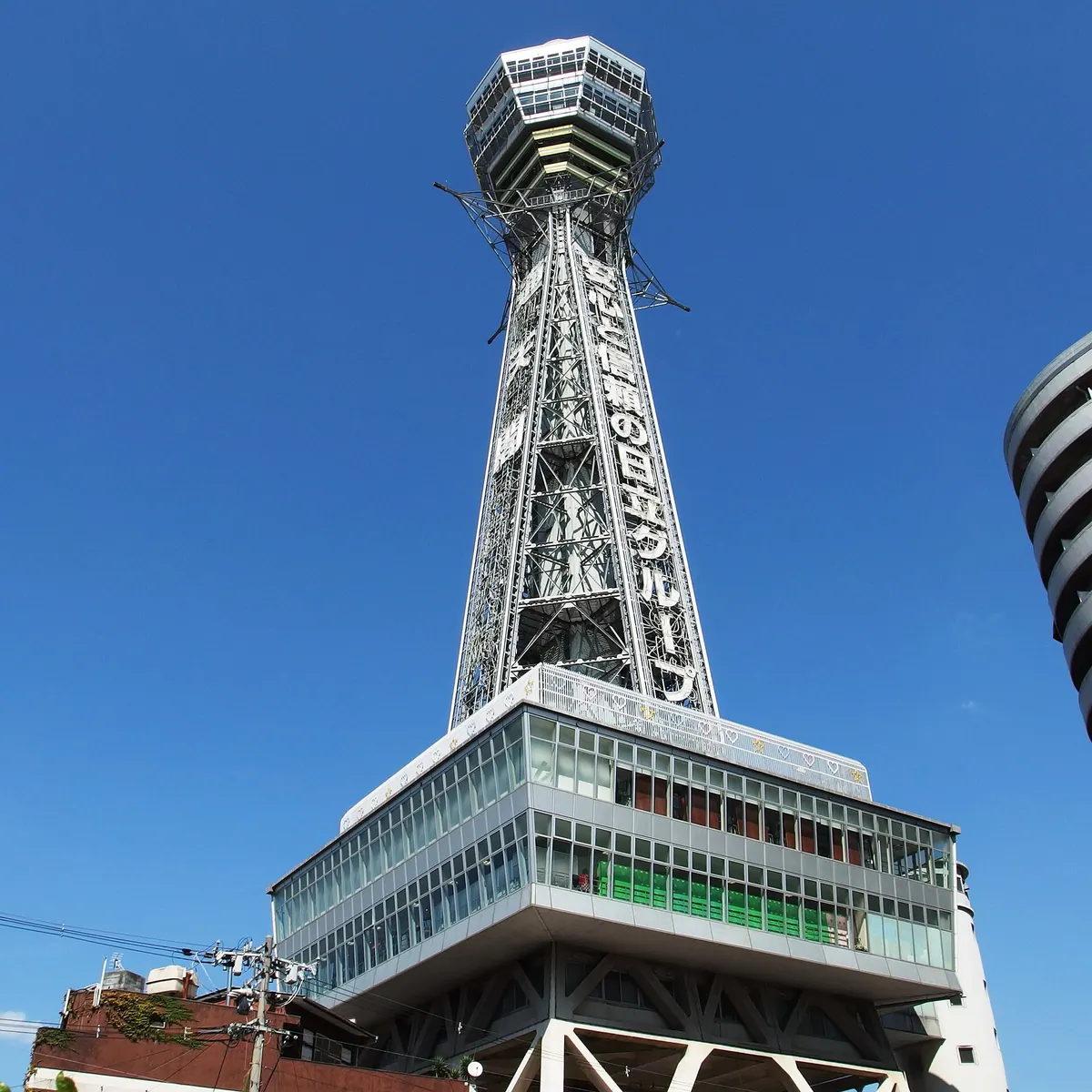
What it is
- Osaka's well-known landmark tower, 103 meters high.
- Original tower built in 1912, current one in 1956.
- Symbol of hope and recovery after World War II.
What to see
- Restored frescoes under the tower.
- Waku Waku Land with snack brand stores in the basement.
- Tower Slider, a 60-meter luge-like ride.
- Kinniku-man area and souvenir store on the Underfloor.
- Open-air Tenbo Paradise viewing platform at 94.5 meters.
- Shrine to Billiken on the Golden Observation Platform.
When to go
- Tower Slider opened in 2022.
In detail
The Tsutenkaku tower is one of Osaka’s best-known landmarks, standing 103 meters high at the center of what is popularly called the city’s “Deep South” district. Its story reflects the city’s own struggles and triumphant rebirth during the twentieth century.
The original Tsutenkaku was the 64-meter-high centerpiece of Shinsekai (“New World”), a neighborhood developed in 1912 on a former exposition site. The north half of Shinsekai was modeled after Paris and the south half after New York’s Coney Island. Tsutenkaku embodied this fusion: its design combined elements from the Arc de Triomphe and the Eiffel Tower, and it was connected via aerial cable car to Luna Park, an amusement park to the south. At night, Tsutenkaku glowed with cutting-edge electric lighting, proudly advertising the city’s prosperity and modernity.
But Luna Park closed in 1923, and when Tsutenkaku was damaged by fire in 1943, it was dismantled for its steel rather than repaired. The tower was absent from the skyline for more than a decade, but following a grassroots campaign to build a new Tsutenkaku as a symbol of hope and recovery after World War II ended, the current tower was completed in 1956. Its architect was Naito Tachu, who would go on to build Tokyo Tower two years later.
Fun for All Inside
A visit to Tsutenkaku starts at street level, in the space under the tower. The frescoes overhead are restored versions of the originals from the 1912 tower. Visitors enter the cheerfully diverse interior of the tower via the basement, which is mostly occupied by Waku Waku Land, a selection of themed stores run by well-known snack brands. The basement also contains the ticket window for the Tower Slider, a 60-meter-long luge-like ride that spirals downward around the elevator from three stories above to come back out in the basement in just 10 seconds. The Tower Slider, which opened in 2022, is the latest example of how Tsutenkaku continues to entertain visitors in new and unexpected ways.
The level above Waku Waku Land is the Underfloor, which contains an area devoted to Kinniku-man (“Muscle Man”), a superhero created by two Osaka-born manga artists; the official Tsutenkaku souvenir store; and a child-friendly parody of the nearby entertainment area Janjan Yokocho, complete with witty signage.
From the Underfloor, the Observation Elevator takes visitors up to the viewing decks. The highest, at 94.5 meters, is an open-air platform called Tenbo Paradise. Below that is the Golden Observation Platform (87.5 meters), with a shrine to tower mascot Billiken, and below that is the Light Observation Platform (84 meters), which is equipped with telescopes. All the viewing decks offer a fine view of the Shinsekai area and its surroundings, including sights like Osaka Castle to the north and Minato-ohashi Bridge across Osaka Bay to the west.
The elevator back down from the viewing decks stops at a “Landing” floor dedicated to the history of Tsutenkaku and Shinsekai. It includes a diorama of the area in its early heyday and a short video presentation of period photography and footage tracing the history of Tsutenkaku from its first incarnation to its current form.
Billiken and the Spirit of Shinsekai
Tsutenkaku is full of quirky and surprising details, but one particularly notable element is the ubiquitous presence of Billiken, “God of Things as They Ought to Be.” This mischievous-looking imp has become the unofficial mascot of the tower and even Osaka more generally, but many visitors are surprised to learn that he is not Japanese in origin.
Billiken was invented in the early twentieth century by the American artist Florence Pretz, who said that he came to her in a dream. The strange creature soon grew so popular that he became known even in Japan, and found his way to enshrinement in Shinsekai as a piece of fashionable American kitsch. Billiken personifies the true spirit of Shinsekai: a place that embraces fads and fashions from everywhere, but gives them a unique Osaka twist.
Text: 観光庁 地域観光資源の多言語解説文データベース. Reproduced unchanged. The notes above were written from that text by Japan Gems.
Where it is
大阪府大阪市浪速区恵美須東一丁目18番6号 Open in Google Maps
この施設の関係者の方へ
このページは公開情報をもとに Japan Gems が作成し、訪日外国人向けに英語で掲載しています。 写真や情報の追加・修正を承っています。お店の写真に差し替えることもできます。
このページの情報を更新する