
Enkaku-ji
円覚寺
Enkakuji was a Buddhist temple, important for its cultural connections and unique architectural blend.
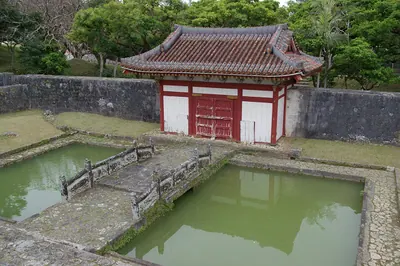
What it is
- Buddhist temple founded by King Sho Shin in 1492.
- Family temple of the Second Sho Dynasty.
- Head temple of the Rinzai Zen Buddhist sect in the kingdom.
- First major Buddhist temple erected in Ryukyu.
What to see
- Current Somon outer gate, reconstructed in 1968.
- Compact site, steeply terraced and enclosed by high stone walls.
- Faces west towards Enkanchi Pond and Bezaitendo hall.
- Stone-walled courtyard with a rectangular lotus pond (Hoshoike).
- Delicately carved Chinese-style stone bridge (Hoshokyo).
- Steep stone staircase to the former Sanmon Gate location.
In detail
Enkakuji was a Buddhist temple located just outside the northern walls of Shuri Castle, sometimes referred to as Tentokuzan. Founded by King Sho Shin in 1492 as the family temple of the Second Sho Dynasty, it was the head temple of the Rinzai Zen Buddhist sect in the kingdom. As the first major Buddhist temple erected in Ryukyu, Enkakuji was an important symbol of the region’s cultural connection with Japan, China, and Korea. It was also strong evidence of the Ryukyuan kings’ adoption of East Asian standards of civilization. After suffering periodic fires and making extensive restorations over the centuries, the temple was destroyed during the Battle of Okinawa in 1945. The current Somon outer gate, a reconstruction completed in 1968, is the sole existing wooden structure.
Site and Layout
The compact site of Enkakuji is steeply terraced and enclosed by high stone walls. It faces west towards Enkanchi Pond and the Bezaitendo hall, forming a unique architectural ensemble. The overall layout was inspired by, and named after, Engakuji Temple in Kamakura, built 200 years earlier. Seven main buildings were sited along a clear central axis, an arrangement common to Zen Buddhist temples known as shichido garan, or “seven hall compound.” The Somon outer gate, which originally housed a flanking pair of Nio guardian statues, leads to a stone-walled courtyard with a rectangular lotus pond called Hoshoike in the center. This is spanned by a delicately carved Chinese-style stone bridge called Hoshokyo, possibly brought from China as a gift. From there the path leads to a steep stone staircase that climbs to the location of what was the large, two-storied Sanmon Gate, with the temple’s central building—the two-storied Buddha Hall—occupying the courtyard beyond. Other important structures included a Great Hall, a bell tower, and a lecture hall.
International Influences
Enkakuji beautifully blended Japanese, Chinese, and possibly Korean influences with local Ryukyuan materials and design sensibility. The complex wooden bracketing that supported the eaves is typical of Zen architecture, but overall, the structures were more massive and rugged than the Japanese Zen temples from which they were derived. The stone-walled first courtyard feels as if it is sunken into the earth, and is reminiscent of the nearby Tamaudun Royal Mausoleum.
Text: 観光庁 地域観光資源の多言語解説文データベース. Reproduced unchanged. The notes above were written from that text by Japan Gems.
Where it is
Enkaku-ji Open in Google Maps
この施設の関係者の方へ
このページは公開情報をもとに Japan Gems が作成し、訪日外国人向けに英語で掲載しています。 写真や情報の追加・修正を承っています。お店の写真に差し替えることもできます。
このページの情報を更新する