
Hetsu-gū
辺津宮
Hetsu-gū is the most accessible of Munakata's three shrines, with important cultural properties and an ancient ritual site.
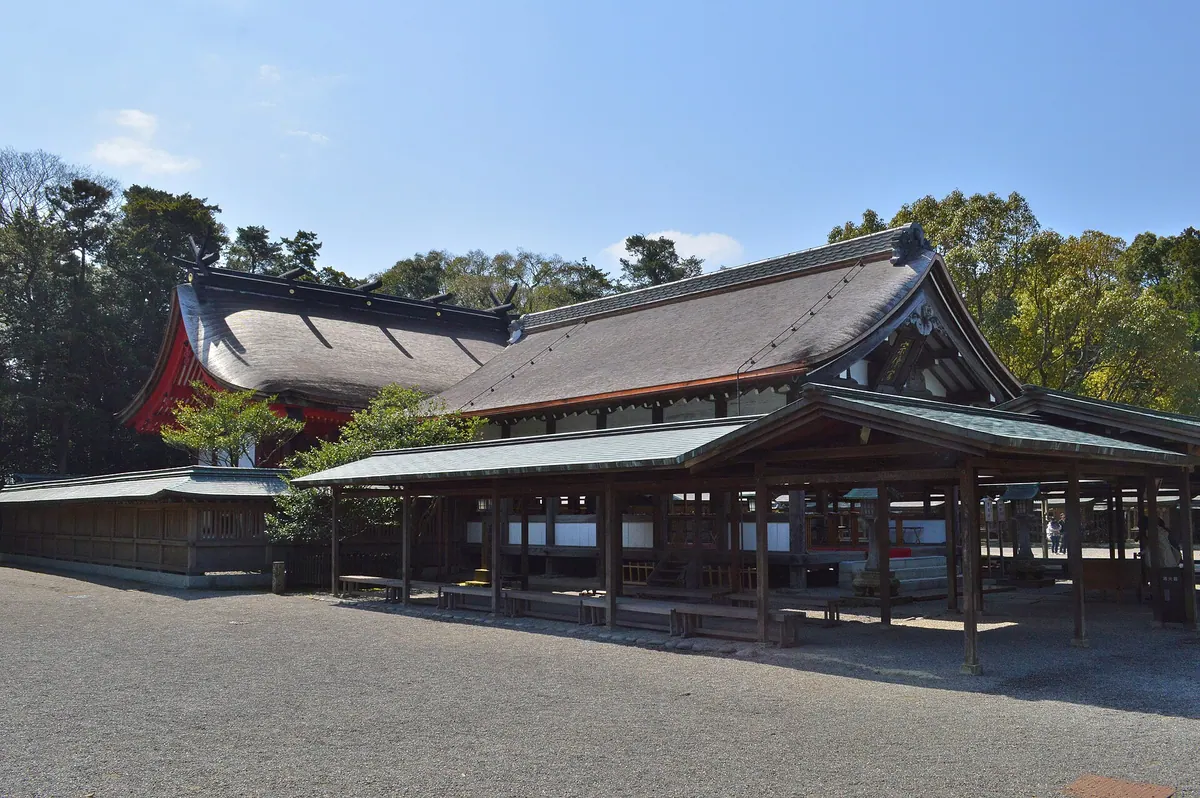
What it is
- One of Munakata's three shrines, also called Munakata Taisha.
- Dedicated to Ichikishimahime no Kami, a female deity.
- Main sanctuary and worship hall are Important Cultural Properties.
What to see
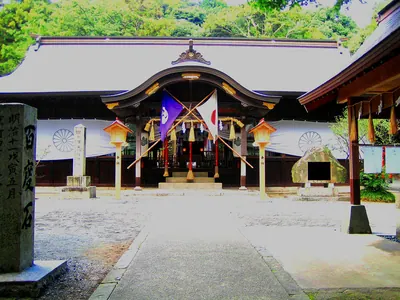
- Torii gate and main gate with imperial chrysanthemum seal.
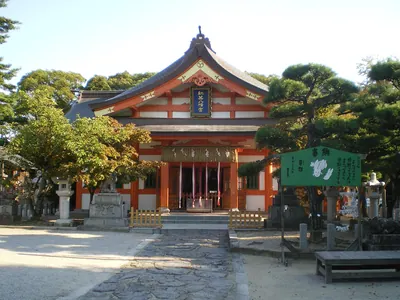
- Worship hall built in 1590.
- Main sanctuary rebuilt in 1578, similar to Itsukushima Shrine.
- Takamiya Saijo, an ancient ritual site.
- View of the sea route to Okinoshima.
- Shimpokan Museum with 80,000 artifacts from Okinoshima.
Getting there
- Located near the Tsurikawa River.
In detail
Hetsu-miya Shrine, located near the Tsurikawa River, is commonly referred to as Munakata Taisha and is the most accessible of Munakata’s three shrines. The main sanctuary and worship hall have been designated Important Cultural Properties. Hetsu-miya enshrines Ichikishimahime no Kami, the youngest sister of the Three Female Deities of Munakata.
Entering the Shrine
Passing through the torii gate and proceeding along the path, you come to the main gate (shinmon), decorated with the gold chrysanthemum seal of the imperial family, commonly seen at Shinto shrines. Beyond the main gate are the worship hall and the main sanctuary. Before passing through the main gate, most visitors stop at the temizuya water pavilion to wash their hands and mouth with cool, flowing water in an act of purification.
The Main Sanctuary
The worship hall, the first structure you see after passing through the main gate, was constructed in 1590. The main sanctuary behind the worship hall was rebuilt after a fire in 1578 by Munakata Ujisada, who was at the time the highest-ranking priest at the shrine. The appearance of the sanctuary, from its curved roof thatched with cypress bark to its intricately carved red eaves, is similar to the design of Itsukushima Shrine at Miyajima in Hiroshima (which was also built to honor the Three Female Deities). Adjacent to the main sanctuary and worship hall are several small subsidiary shrines, which were relocated here from other sites in the Munakata region in 1675.
An Ancient Ritual Site
To the right of the main sanctuary, a path leads up to Takamiya Saijo, the site where the Three Female Deities are said to have descended to earth from the heavens. Takamiya Saijo has been an important ritual site for over a thousand years, predating the shrine itself. To the northwest of the ritual site you can see the sea route linking Hetsu-miya with Okinoshima across the Genkai Sea. As you descend, watch for a path leading to two subsidiary shrines venerating Tagorihime no Kami of Okitsu-miya, and Tagitsuhime no Kami of Nakatsu-miya.
To learn more about the ancient rituals conducted in the Munakata region, visit the Shimpokan Museum within the Hetsu-miya precincts. The museum holds around 80,000 artifacts found at ritual sites on Okinoshima.
Text: 観光庁 地域観光資源の多言語解説文データベース. Reproduced unchanged. The notes above were written from that text by Japan Gems.
Where it is
Hetsu-gū Open in Google Maps
この施設の関係者の方へ
このページは公開情報をもとに Japan Gems が作成し、訪日外国人向けに英語で掲載しています。 写真や情報の追加・修正を承っています。お店の写真に差し替えることもできます。
このページの情報を更新する