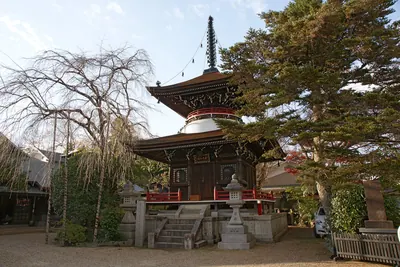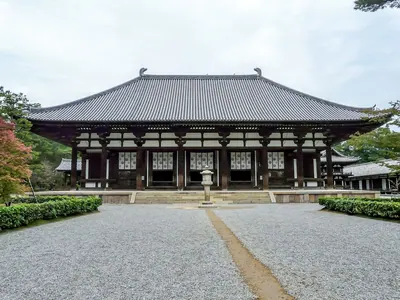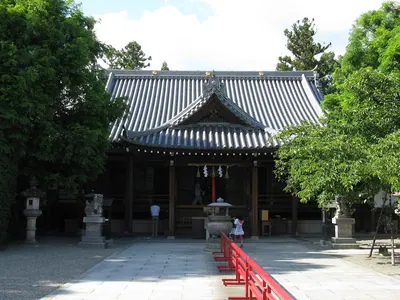

Isonokami Jingū
石上神宮
This ancient, tree-shaded shrine offers a deep historical experience and unique cultural artifacts.

What it is
- One of the oldest shrines in Japan.
- Founded around 91 BCE by the Mononobe clan.
- Site of the annual chinkonsai ritual for over 2,000 years.
What to see
- Small, tree-shaded grounds.
- Roaming flocks of fowl.
- Houses the Futsu no Mitama sword.
- Houses the seven-branched sword called the Shichishitō.
In detail
This small, tree-shaded shrine on the eastern outskirts of Tenri is best known today for its roaming flocks of fowl, but Isonokami Jingū’s modest grounds bely the depth of its history. As one of the oldest shrines in Japan, Isonokami Jingū traces its roots back through history and legend. It began as a center of spiritual power and a storehouse for ancient relics, and for over 2,000 years, it has been the site of the annual chinkonsai (p. XX), an ancient ritual to pray for the long life of the imperial family and the well-being of the country.
The shrine was founded around 91 BCE by the Mononobe clan, who served the imperial court as warriors as well as in religious matters. The shrine was built to house the Futsu no Mitama sword, a divine blade said to have been wielded by the first Japanese emperor. Today, Isonokami Jingū houses many sacred artifacts, including the seven-branched sword called the Shichishitō (p. XX), believed to have been brought from the kingdom of Baekje (18 BCE–660 CE) on what is now the Korean Peninsula. Over the course of history, the shrine has dutifully continued to serve the imperial family as a caretaker of many priceless treasures.
Text: 観光庁 地域観光資源の多言語解説文データベース. Reproduced unchanged. The notes above were written from that text by Japan Gems.
Where it is
奈良県天理市布留町 Open in Google Maps
この施設の関係者の方へ
このページは公開情報をもとに Japan Gems が作成し、訪日外国人向けに英語で掲載しています。 写真や情報の追加・修正を承っています。お店の写真に差し替えることもできます。
このページの情報を更新する