
Shimabara Castle
島原城
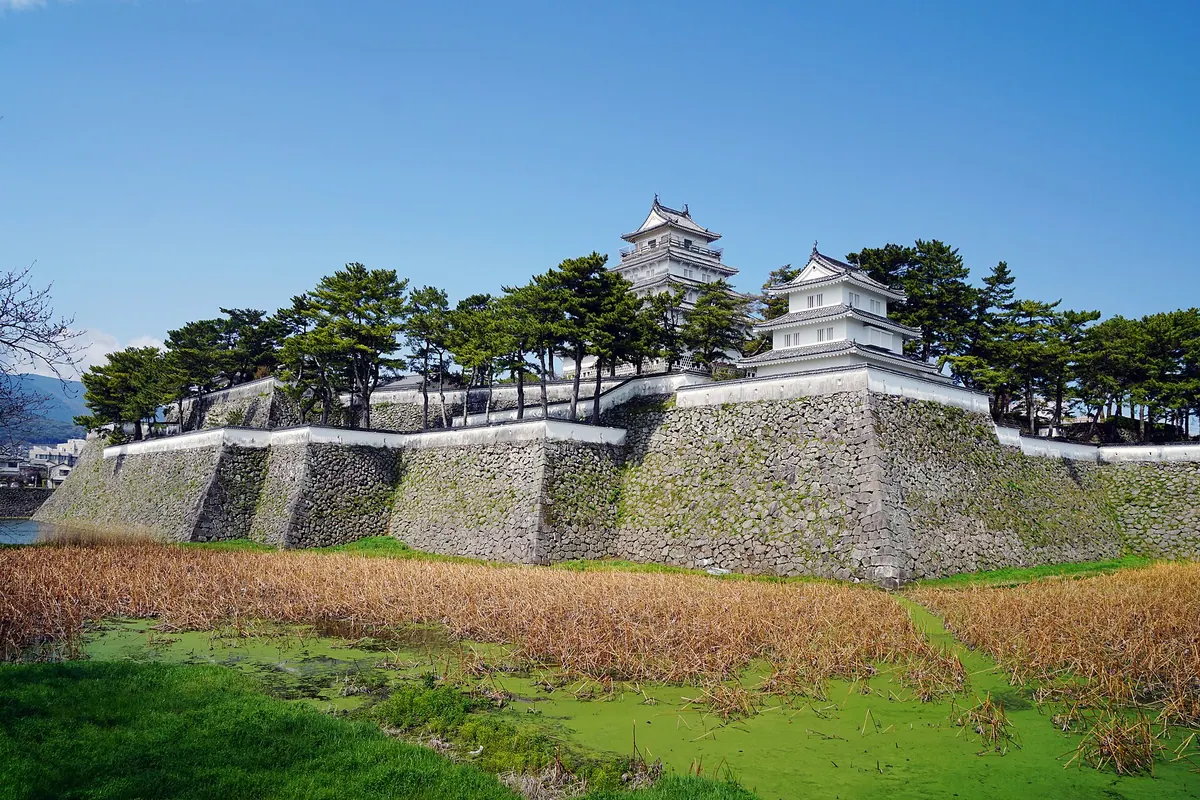
This castle, a 1964 reproduction, offers a museum about Christian history and views of the sea.
What it is
- Reproduction of a grand castle, completed in 1964.
- Original castle built from 1616 to 1625.
- Contains a museum about local history and Christianity.
What to see
- Museum exhibits on Christianity on the second floor.
- English panels explain Christian history in Shimabara.
- Fumi-e ritual manual, picture tablets, and registers.
- Samurai armor of the Matsudaira family on the third floor.
- Views of the sea and mountains from the roof.
- Bird's-eye view of the castle's turrets, walls, and moat.
In detail
In 1616, the shogunate sent Matsukura Shigemasa (1574–1630) from Yamato Province to administer the Shimabara region as a reward for martial prowess. Shimabara had been Christian until the death of its daimyo Arima Harunobu in 1612. Shogun Tokugawa Hidetada, who banned the religion in 1614, wanted someone who would persecute the local Christians with greater zeal than Harunobu’s son had been able to muster.
Upon his arrival, Matsukura’s first priority was to build a grand castle. By raising taxes and forcing the populace to help with construction, he ended up with a castle that was far bigger than the income from the relatively modest 40,000 koku (200,000 bushels) of rice produced annually by the Shimabara domain could justify. It took seven years to build, and once it was complete in 1625, Matsukura no longer had any reason to show restraint. He began persecuting the Christian population, first by boiling them alive in the volcanic springs at Unzen, and later by torturing them until they renounced their faith.
Shigemasa’s son Matsukura Katsuie (1598–1638) inherited the domain in 1630. He maintained his father’s policies of harsh taxation and brutal punishment, while conditions for the peasantry were made even worse by a run of poor harvests. All this misery culminated in the Shimabara Rebellion (1637–1638). In part because the castle was constructed on such a grand scale, the shogunate forces survived the attacks of the well-armed and well-led Shimabara rebels who eventually withdrew. Katsuie, however, did not survive for long. He was executed in 1638, and the castle passed through a succession of different daimyo families.
The castle was demolished following the 1873 decree of the Meiji government. The present structure is actually a ferroconcrete reproduction dating from 1964. It contains a museum that features objects relating to Christianity on the second floor. A series of panels explains in English the history of Christianity in Shimabara in great detail. Among the exhibits are a manual for civil servants on how to administer the fumi-e ritual of trampling Christian images, fumi-e picture tablets, and the registers that Shimabara residents were made to sign to show they had completed the annual fumi-e ritual.
The third floor contains a display of samurai armor belonging to the Matsudaira family. It is also well worth going up to the roof for views of the sea and the mountains, and for a bird’s-eye view of the castle’s turrets, walls, and moat.
Text: 観光庁 地域観光資源の多言語解説文データベース. Reproduced unchanged. The notes above were written from that text by Japan Gems.
Where it is
Shimabara Castle Open in Google Maps
この施設の関係者の方へ
このページは公開情報をもとに Japan Gems が作成し、訪日外国人向けに英語で掲載しています。 写真や情報の追加・修正を承っています。お店の写真に差し替えることもできます。
このページの情報を更新する