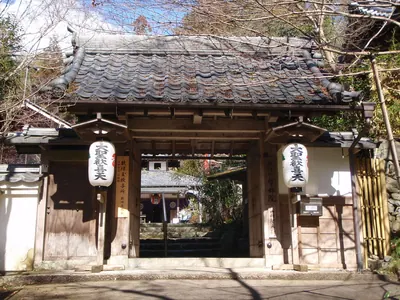

Shōryū-ji Temple
勝龍寺
This temple, founded by Kukai, offers unique kirie art and a monthly market with local goods.
What it is
- Buddhist temple, Shingon school.
- Established in 806 by monk Kukai.
- Named after a Chinese temple where Kukai studied.
What to see
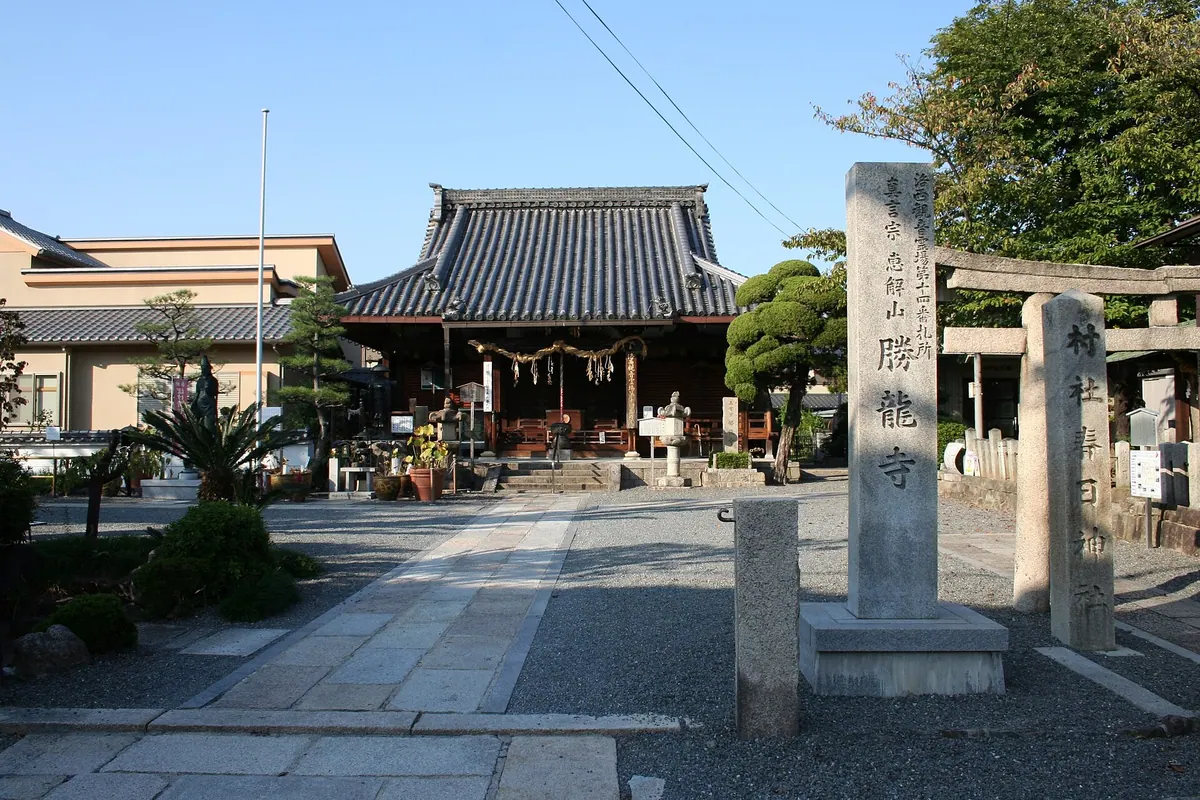
- Sacred rope shaped like a dragon over Hondo entryway.
- Statue of Kukai as a traveling monk.
- Statue of Bokefuji Kannon.
- Statue of Hotei, one of the Seven Gods of Fortune.
- Statue of arhat Binzuru Sonja.
- Small Kasuga Jinja Shrine dedicated to Shinto deities.
When to go
- Second Sunday of each month for Hotei Market.
- Market not held in January and August.
In detail
According to temple legend, the monk Kukai (Kobo Daishi, 774–835), the founder of the Shingon school of Buddhism, established Shoryuji in 806. He named it after a temple in China where he had studied, with kanji characters for “blue dragon.” It is said that during a severe drought in 962, the emperor ordered the chief abbot Senkan (918–984) to spend a week praying for rain. After the long-awaited rain fell, the characters for the temple name were changed to mean “victory over the dragon,” reflecting how the power of prayer overcame the will of the divine creature ruling over water.
Hondo (Main Hall) and Temple Grounds
Hanging over the Hondo entryway is a sacred rope shaped like an undulating dragon flying west toward the Nishiyama mountains. At the beginning of each year, community members make a new sacred rope by hand. Historically, the quality of the resulting rope was used to predict how bountiful the year’s harvest would be. The principal object of worship at Shoryuji is a statue of the Eleven-Headed Kannon, the bodhisattva of compassion. It dates to the Kamakura period (1185–1333) and is a nationally designated Important Cultural Property kept at the Kyoto National Museum outside of special ritual periods. Please note that the Hondo is generally closed to the public.
The temple grounds contain statues of Kukai as a traveling monk, Bokefuji Kannon believed to protect against dementia, Hotei (one of the Seven Gods of Fortune), and the arhat Binzuru Sonja reputed to have healing powers. A small Kasuga Jinja Shrine is dedicated to Shinto deities that guard the area around Shoryuji.
Art and Community Engagement
Shoryuji is known for kirie, the art of intricate paper cutting, offering items such as kirie temple seals (goshuin), omamori amulets, and art prints. Temple staff hold kirie workshops (reservation required), as well as yoga classes. On the second Sunday of each month except January and August, Shoryuji hosts the Hotei Market where people from the neighborhood sell homemade food, crafts, and eco-friendly goods, and musicians give small performances.
Text: 観光庁 地域観光資源の多言語解説文データベース. Reproduced unchanged. The notes above were written from that text by Japan Gems.
Where it is
京都府長岡京市勝竜寺19-25 Open in Google Maps
この施設の関係者の方へ
このページは公開情報をもとに Japan Gems が作成し、訪日外国人向けに英語で掲載しています。 写真や情報の追加・修正を承っています。お店の写真に差し替えることもできます。
このページの情報を更新する