
Shukkei-en
縮景園
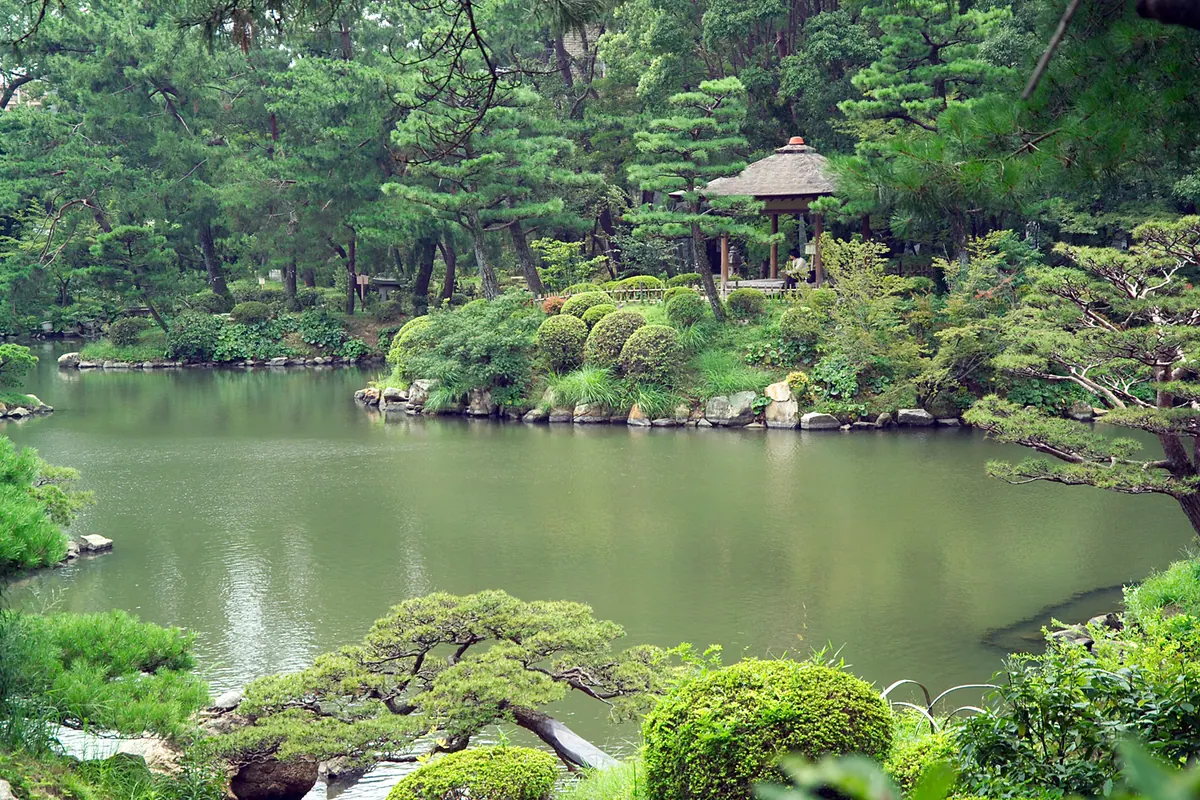
Shukkei-en is a historic Japanese garden in Hiroshima, worth visiting for its beauty and atomic bombing scars.
What it is
- Hiroshima’s famous Japanese garden.
- Created in 1620 for the Asano family.
- Designed by tea master Ueda Soko.
- Name means “shrunken scenic garden.”
What to see
- Lake Takueichi with 14 islands.
- Arched stone bridge.
- Bridges, valleys, teahouses, and arbors.
- Chozenkyo Pavilion.
- Three trees that survived the atomic bombing.
- Memorial to A-bomb victims.
In detail
Shukkeien, Hiroshima’s famous Japanese garden, is deeply entwined with local history spanning centuries ago through to the city’s darkest hour in 1945. Scars from the atomic bombing are visible here if one knows where to look, but they in no way detract from Shukkeien’s year-round splendor. Rather, the traces of Hiroshima’s tragic A-bomb experience serve to somehow emphasize the beauty of nature.
The garden was originally created in 1620 for the Asano family, which ruled over the region, by tea master Ueda Soko (1563–1650), a high-level advisor to the family. The name Shukkeien translates as “shrunken scenic garden,” signifying how the garden elegantly encapsulates tranquil mountain and river views in a walkable area roughly the size of a baseball stadium.
Shukkeien is representative of a style of Japanese garden known as kaiyushiki teien (“excursion-style garden”). The manmade but natural-looking Lake Takueichi, which dominates the garden’s center, is dotted with 14 large and small islands (seven on either side of the lake’s arched stone bridge) that represent the islands of the nearby Seto Inland Sea. Surrounding the lake and unfolding across the garden are carefully placed features such as bridges, valleys, teahouses, and arbors.
Extensive renovations were undertaken here between 1783 and 1830, leaving the Chozenkyo Pavilion and its surrounding landscape the only features remaining from Ueda’s original plans. The atomic bombing of August 6, 1945 inflicted severe damage on Shukkeien, destroying every one of its structures, save for the stone bridge. The structures were rebuilt following the war.
Scars of the atomic bombing that can be seen on a circuit around Shukkeien include three of only 161 trees in Hiroshima confirmed to have survived the resulting conflagration. One is a ginkgo tree said to infuse people with part of its spirit when touched. Another, the tallest of the surviving trees, is a pine tree situated close to the Enko River, which borders Shukkeien on its eastern side. Also near the river is a memorial to victims of the A-bomb. This was built following the discovery of photos showing that bodies had been buried in makeshift graves in the garden following the attack.
Text: 観光庁 地域観光資源の多言語解説文データベース. Reproduced unchanged. The notes above were written from that text by Japan Gems.
Where it is
広島市中区上幟町2-11 Open in Google Maps
この施設の関係者の方へ
このページは公開情報をもとに Japan Gems が作成し、訪日外国人向けに英語で掲載しています。 写真や情報の追加・修正を承っています。お店の写真に差し替えることもできます。
このページの情報を更新する