
Assumption of Mary Cathedral, Hiroshima
世界平和記念聖堂
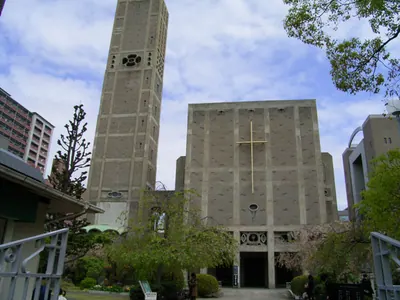
This modern cathedral commemorates war victims and promotes peace, featuring a unique blend of Japanese and Western design.
What it is
- Memorial Cathedral for World Peace, completed 1954.
- Designated Important Cultural Property.
- Venue for people of all beliefs to pray for world peace.
- Place of worship for Catholics.
What to see
- Modern architecture with Japanese symbolism and Western elements.
- Japanese-inspired bridge outside.
- Tall wooden gate, inspired by Shinto torii gates.
- Phoenix on the roof instead of a cross.
- Lamps shaped like lotus flowers inside.
- Windows with bamboo, pine, and ume plum motifs.
When to go
- Completed on August 6.
In detail
An impressive example of modern architecture, the Memorial Cathedral for World Peace was completed in 1954 and is a designated Important Cultural Property. The cathedral was built to serve as a venue where people of all beliefs are invited to pray for world peace and remember the victims of both the Hiroshima A-bomb and World War II, as well as to function as a place of worship for Catholics. The interesting blend of Japanese symbolism with the Western elements in the cathedral’s design makes it a worthwhile visit.
The roots of the Memorial Cathedral for World Peace lie in a small German Catholic congregation that worshipped in this area before World War II. Its prayer house was destroyed in the atomic bombing, and in the immediate aftermath of the attack, the priests, led by Father Hugo Lassalle (1898–1990), tended to the injured at the nearby Shukkeien Garden. After the war ended, Father Lassalle became determined to build a truly special cathedral: one dedicated to peace, where the victims could be mourned and remembered and which would help lift the city’s spirits. He traveled to Rome and the United States seeking support for his project. He was ultimately able to purchase a sizable plot of land, after which his church held a competition for the project’s design. The commission was eventually awarded to architect Murano Togo (1891–1984).
Construction began in 1950, with work completed four years later on the deeply significant date of August 6. The cathedral possesses a simple, clean-lined design that exudes warmth, calm, and a spirit of reverence. Before entering, keen-eyed visitors will note the Japanese-inspired bridge outside, as well as a tall wooden gate at the start of the path leading to the cathedral’s entrance: the latter detail was inspired by the torii gates of Shinto shrines. Up above, a clearly symbolic phoenix on the roof takes the place of the usual cross.
Inside, notable Japanese elements include lamps in the shape of lotus flowers (an acknowledgement of gratitude to Buddhist donors) and windows incorporating bamboo, pine, and ume plum motifs. A huge centerpiece image of Christ bearing the cross—the latter rendered in gold—dominates the main hall.
Text: 観光庁 地域観光資源の多言語解説文データベース. Reproduced unchanged. The notes above were written from that text by Japan Gems.
Where it is
Assumption of Mary Cathedral, Hiroshima Open in Google Maps
この施設の関係者の方へ
このページは公開情報をもとに Japan Gems が作成し、訪日外国人向けに英語で掲載しています。 写真や情報の追加・修正を承っています。お店の写真に差し替えることもできます。
このページの情報を更新する