
Hikone Castle
彦根城
Hikone Castle is a well-preserved castle with strategic significance, worth visiting for its historical architecture.
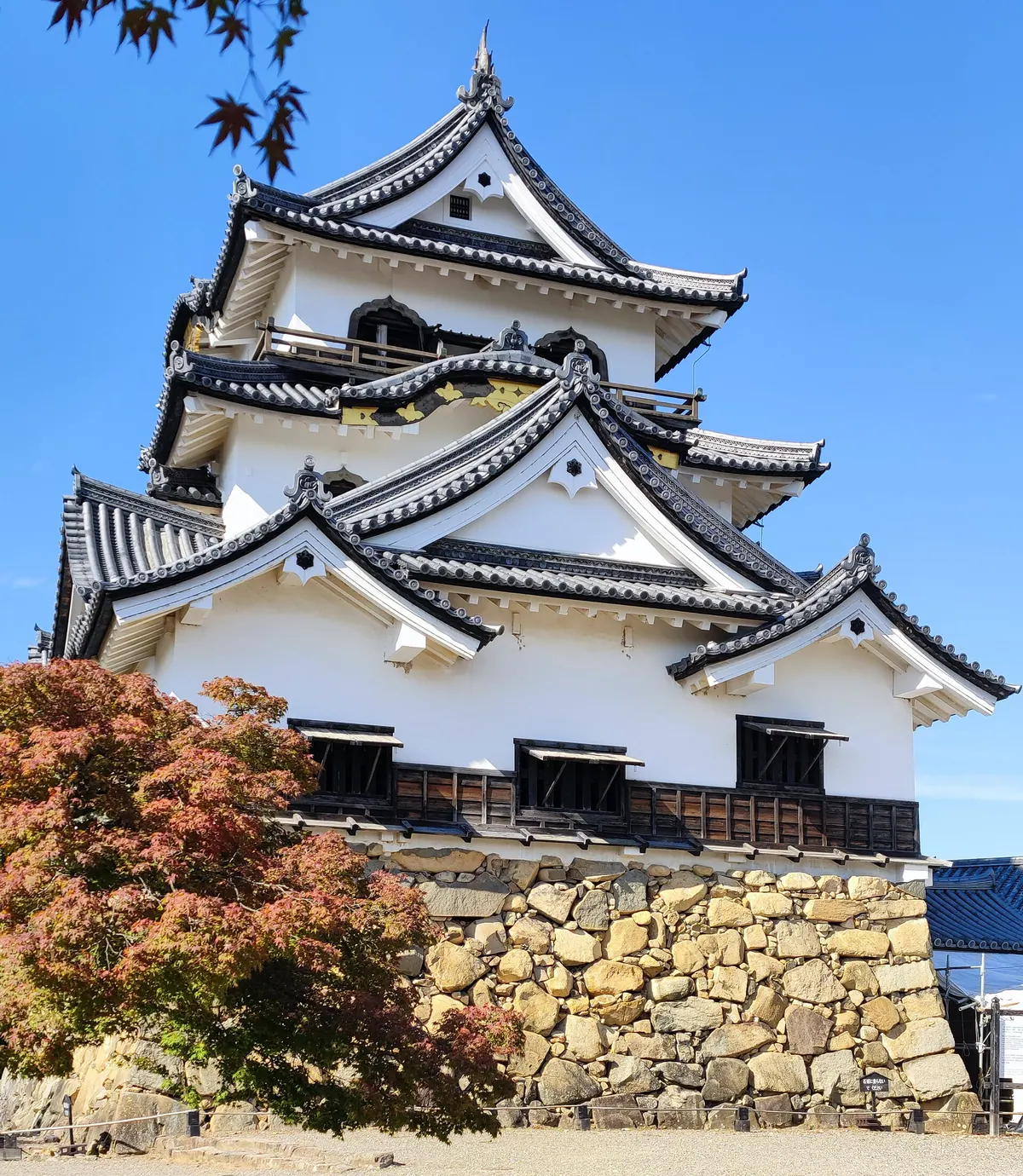
What it is
- One of Japan's best-preserved castles.
- Built by the Ii family in the early 17th century.
- Constructed on orders of shogun Tokugawa Ieyasu.
- Strategic location on Lake Biwa and Nakasendō road.
What to see
- Main keep on Mt. Hikone's flattened top.
- Multiple walled baileys.
- Inner and middle moats.
- Stone foundations around the main bailey.
- Omote goten with meeting chambers and stroll garden.
- Buildings designated as Important Cultural Properties.
In detail
Hikone Castle was built by the newly appointed lords of Hikone, the Ii family, in the first decades of the seventeenth century. The castle was constructed on the orders of shogun Tokugawa Ieyasu (1534–1616), who wanted to prevent opposing daimyo from joining forces and threatening his newly created government. Hikone had great strategic significance, being situated on Lake Biwa and along the Nakasendō, one of two main roads that connected the capital of Edo (now Tokyo) to western Japan. Lake Biwa could be used to reach Kyoto by boat, and it was a fundamental part of the area’s transportation network. Furthermore, if a daimyo from the west moved to attack the shogunate at the capital, they would likely approach via the Nakasendō.
The castle was assigned to Ii Naomasa (1561–1602) in recognition of his performance in battle. Naomasa died soon after receiving the position, and his son Naotsugu (1590–1662), who succeeded him as daimyo, built most of the castle complex between 1604 and 1607. Naotsugu was replaced by his brother-in-law, Ii Naotaka (1590–1659), who completed the castle and the lord’s residence (omote goten) in 1622.
Hikone Castle is one of the best-preserved castles in Japan, and a number of its buildings have been designated Important Cultural Properties. Many of its features are typical of the hilltop castles of Japan’s medieval period (twelfth to sixteenth centuries), other aspects show the role of Japanese castles shifted during the seventeenth century from strongholds to centers of administration. For example, the stone foundations that surround the main bailey (honmaru) strongly recall the hilltop castles of the Warring States period (1467–1568), but Hikone’s omote goten has chambers that were used for public meetings and administration, as well as a stroll garden and multiple tearooms for entertaining government officials.
As a stronghold, Hikone Castle has several layers of fortifications. Its main keep was built on the flattened top of Mt. Hikone, at the center of several walled baileys. The castle grounds were also once encircled by three concentric moats, of which the inner and middle moats still remain. Despite its defenses and strategically important position, Hikone Castle was never the site of any armed conflict. After the shogunate was overthrown in 1868, in 1873 the Meiji Emperor (1852–1912) issued an order to destroy the old castles as remnants of the Tokugawa regime. Hikone was scheduled for demolition as well, but the castle was saved when the emperor happened to visit the grounds. His councilor, Ōkuma Shigenobu (1838–1922), was struck by the beauty of the main keep and asked him to spare it for posterity. The emperor agreed.
Text: 観光庁 地域観光資源の多言語解説文データベース. Reproduced unchanged. The notes above were written from that text by Japan Gems.
Where it is
Hikone Castle Open in Google Maps
この施設の関係者の方へ
このページは公開情報をもとに Japan Gems が作成し、訪日外国人向けに英語で掲載しています。 写真や情報の追加・修正を承っています。お店の写真に差し替えることもできます。
このページの情報を更新する