
Hiroshima Peace Memorial
原爆ドーム
This memorial is a surviving structure from the 1945 atomic bombing, worth visiting to process the tragedy.
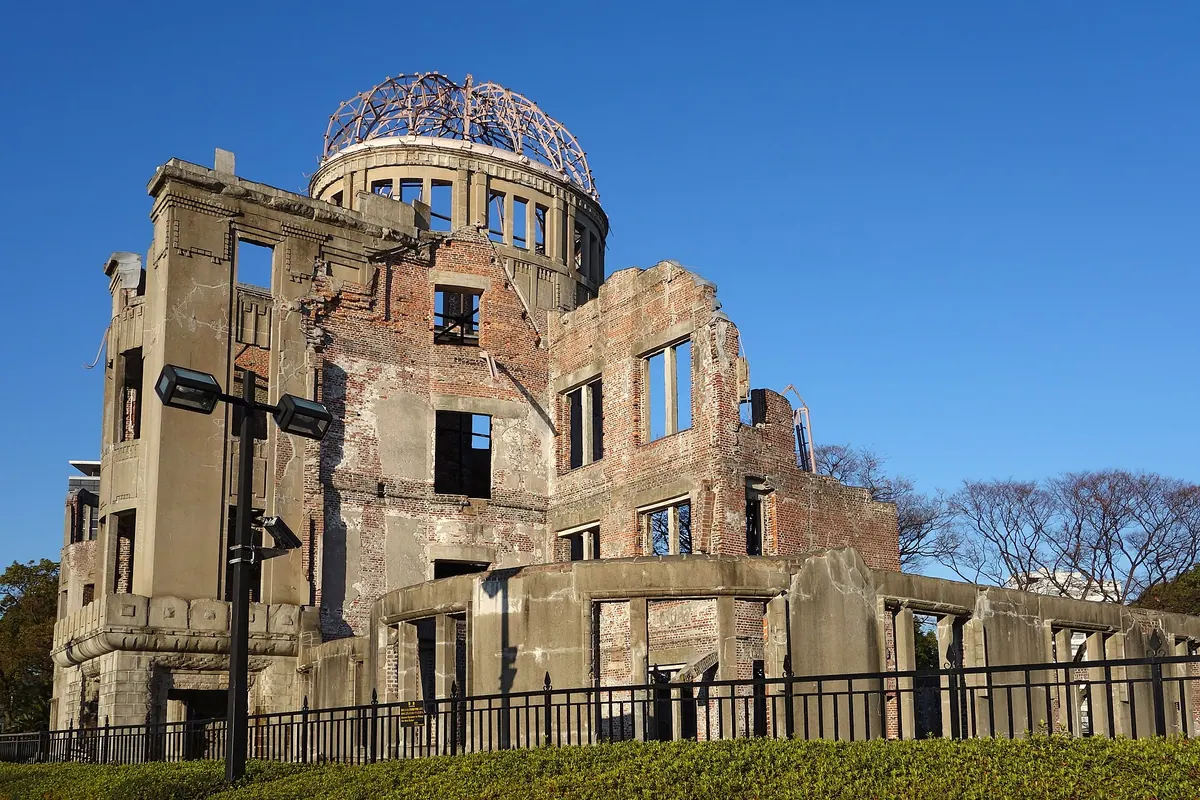
What it is
- Atomic Bomb Dome, also known as Hiroshima Peace Memorial.
- One of few structures near hypocenter that survived 1945 bombing.
- Originally Hiroshima Prefectural Industrial Promotion Hall, opened 1915.
- Designated a UNESCO World Heritage Site in 1996.
What to see
- Twisted steel of the building’s dome.
- Visibly blast-stained concrete walls.
- Lush grass surrounding the structure.
- Reflections in the Motoyasu River.
Getting there
- Located in the northeastern corner of Peace Memorial Park.
In detail
The Atomic Bomb Dome, also known as the Hiroshima Peace Memorial, is one of the largest structures that was left standing after the August 6, 1945, atomic bombing of Hiroshima, and is one of the few surviving structures located in the vicinity of the hypocenter, just 160 meters away. The blast occurred almost directly above the A-bomb Dome, exerting 35 tons of pressure per square meter and generating a wind speed of 440 meters per second. The building burst into flames; most of it was destroyed, and its occupants were killed instantly. Nevertheless, the steel skeleton of the central dome structure, along with the thick concrete walls below it, survived, albeit in the ravaged form seen today.
The twisted steel of the building’s dome, and the visibly blast-stained concrete walls below, contrast strikingly with the lush grass that surrounds the structure today. Although the entire perimeter of the A-bomb Dome can be walked in only a few minutes, it is easy to find that an hour or more has passed as one tries to process the tragedy to which the ruins bear silent witness.
When the bomb was dropped, the district around the A-bomb Dome, which sits in the northeastern corner of Peace Memorial Park, looked very different. This was one of the most bustling parts of the city, and as such was chosen as the location of the government body originally housed in the building, which at the time was called the Hiroshima Prefectural Industrial Promotion Hall. Originally opened in 1915, it was designed by Czech architect Jan Letzel (1880–1925). Even before history came to cast a dark shadow over the structure, it was famed locally as a then-rare example of Western-style architecture. The dome could be seen reflected in the Motoyasu River a stone’s throw away, much as it can today.
In the wake of August 1945, the building’s remains came to be known colloquially as the A-bomb Dome, and people walked around freely inside it. In 1966, a formal decision was made to preserve the structure, and since then work has been carried out to ensure it continues to stand. In 1996, the A-Bomb Dome was designated a UNESCO World Heritage Site.
Text: 観光庁 地域観光資源の多言語解説文データベース. Reproduced unchanged. The notes above were written from that text by Japan Gems.
Where it is
Hiroshima Peace Memorial Open in Google Maps
この施設の関係者の方へ
このページは公開情報をもとに Japan Gems が作成し、訪日外国人向けに英語で掲載しています。 写真や情報の追加・修正を承っています。お店の写真に差し替えることもできます。
このページの情報を更新する