
Kitaguchi Hongū Fuji Sengen Shrine
北口本宮冨士浅間神社
This shrine is the main starting point for the Yoshida Trail to Mt. Fuji's peak.
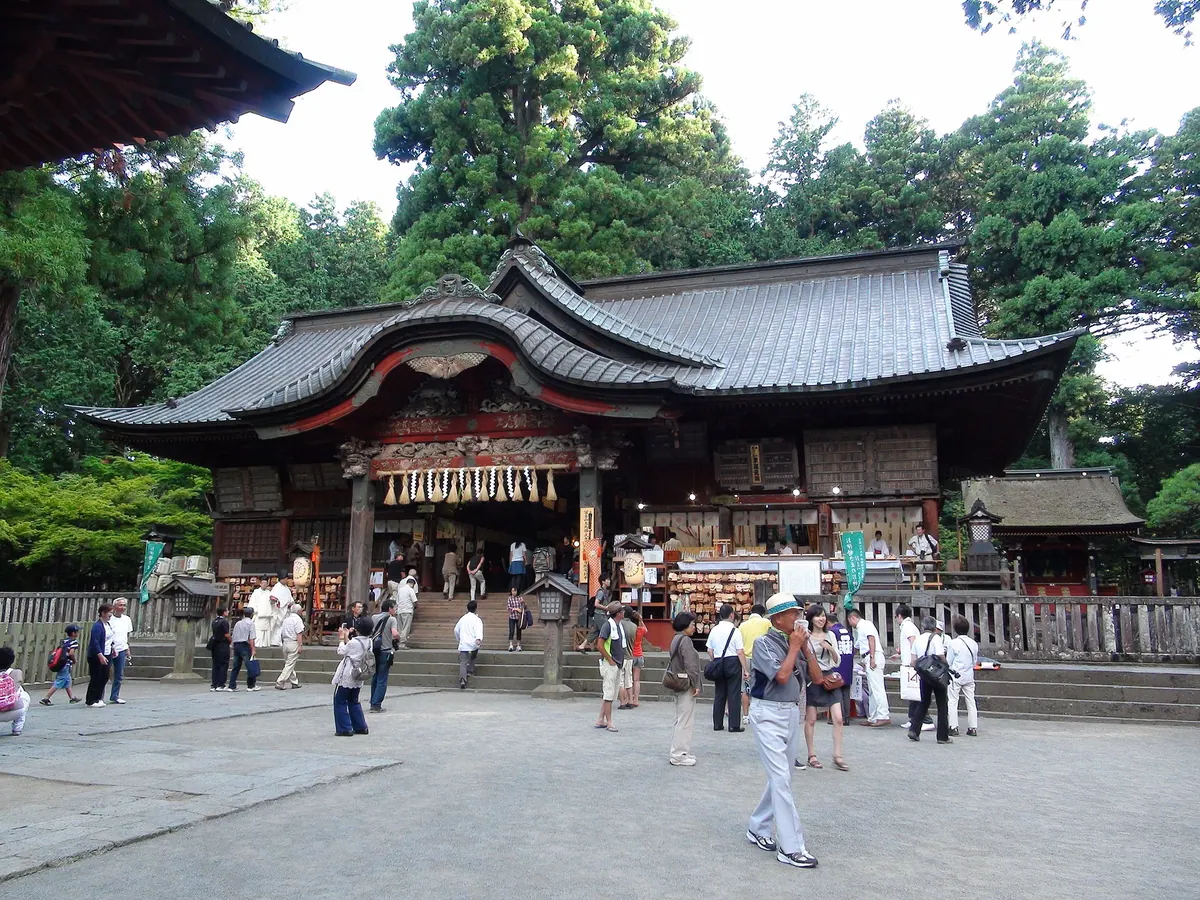
What it is
- Main shrine at the north entrance of the Yoshida Trail to Mt. Fuji.
- Traces origins back to 110 AD, established in 788 AD.
- Most architecture dates from the 17th and 18th centuries.
What to see
- Massive, ancient pines line the approach.
- Imposing torii gate with a sign.
- Current sanctuary building (honden).
- Two former honden, one from 1223, another from 1594.
- Largest honden from 1615.
- Small alcove enshrining Ebisu and Daikokuten.
In detail
Kitaguchi Hongu Fuji Sengen-Jinja Shrine
Kitaguchi Hongu Fuji Sengen-jinja Shrine is the main shrine (hongu) at the north entrance (kitaguchi) of the Yoshida Trail that leads to Mt. Fuji’s peak. In past centuries, it was the starting point of the climb for most pilgrims arriving from Edo (present-day Tokyo).
The shrine traces its origins back to the year 110, when legendary prince Yamato Takeru climbed a nearby hill to pay his respects to Mt. Fuji during an expedition to the east. In 788, the shrine was established in its current location. In the seventeenth and eighteenth centuries, the explosive growth of the Fujiko faith brought a new wave of pilgrims from Edo to the shrine. Most of the shrine architecture dates from this period.
Beyond the massive, ancient pines lining the approach to the shrine stands an imposing torii gate with a sign reading, “The Greatest Mountain in the Three Countries.” The “three countries” were Japan, China, and India, which made up the entire known world in ancient Japan. The torii announces itself as the entrance not just to the shrine, but to Mt. Fuji itself.
The Three Sanctuaries
Alongside the current sanctuary building (honden), two former honden stand in the shrine precincts. The oldest was built in 1223 by Hojo Yoshitoki (1163–1224), second regent of the Kamakura shogunate. In 1561, this was gifted to the shrine by daimyo Takeda Shingen (1521–1573). A newer, grander honden was built in 1594, indirectly funded by Toyotomi Hideyoshi (1537–1598), who had unified the entire country by force of arms less than a decade before. The largest and grandest honden was bestowed in 1615 by retainers of shogun Tokugawa Ieyasu (1543–1616), whose reign ushered in the peace and stability of the Edo period (1603–1868).
Another unusual feature of the shrine is the small alcove enshrining Ebisu and Daikokuten, the Japanese gods of prosperity, at the rear of the building. To pray at this alcove, visitors must turn their back to Mt. Fuji, which is unusual for a Sengen shrine. The positioning may have been chosen so that the two gods could permanently face the mountain.
Text: 観光庁 地域観光資源の多言語解説文データベース. Reproduced unchanged. The notes above were written from that text by Japan Gems.
Where it is
Kitaguchi Hongū Fuji Sengen Shrine Open in Google Maps
この施設の関係者の方へ
このページは公開情報をもとに Japan Gems が作成し、訪日外国人向けに英語で掲載しています。 写真や情報の追加・修正を承っています。お店の写真に差し替えることもできます。
このページの情報を更新する