
Naegi Castle
苗木城
Naegi Castle is worth visiting for its unique integration of natural granite boulders with diverse stone wall techniques.
What it is
- Castle complex built on a mountain.
- Uses natural granite boulders with stone walls.
What to see
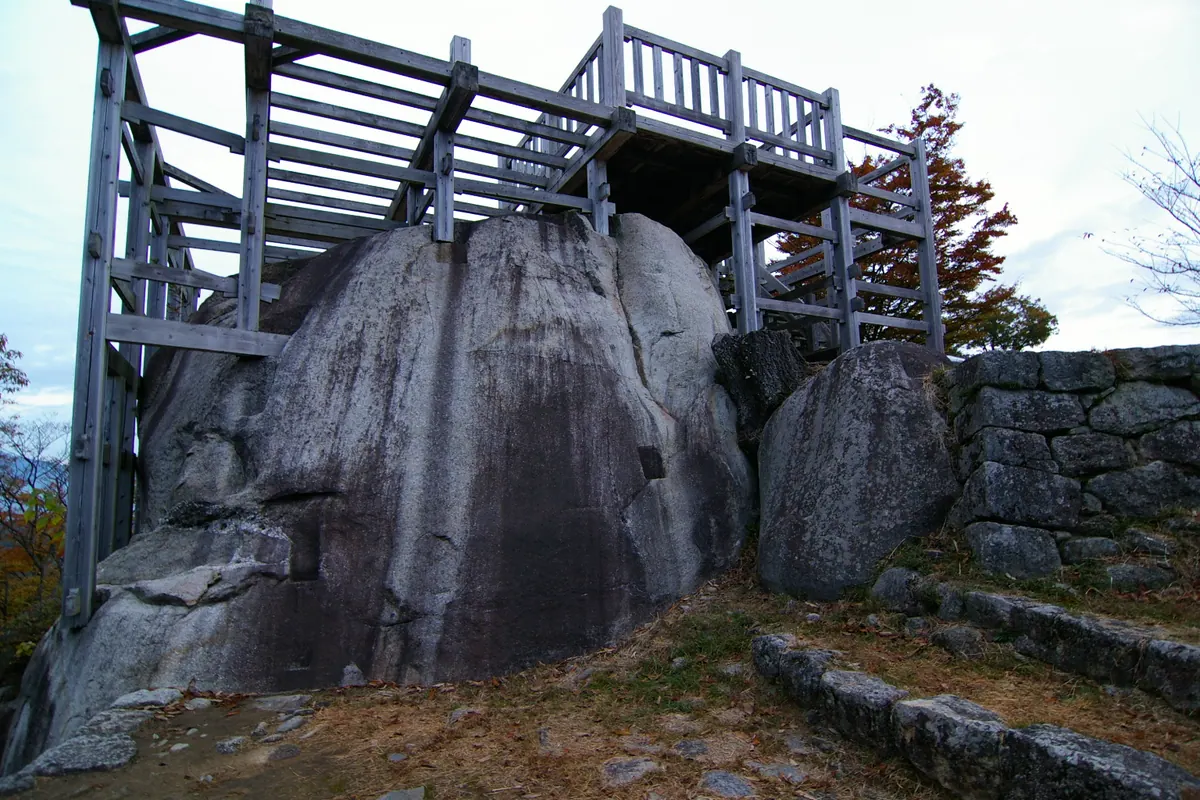
- Oyagura Tower with stone walls hugging natural rock.
- Examples of various stone wall techniques.
- Postholes and indentations carved into large rocks.
- Four kinds of stone walls from different periods.
- Nozura-zumi walls at Watagura Gate and Genkanguchimon Gate.
- Uchikomi walls at Kitamon Gate and Oyagura Tower.
In detail
The outstanding characteristic of the castle complex is how it makes use of the natural granite boulders of the mountain in conjunction with skillfully built stone walls. At sites like the Oyagura Tower, the stone walls hug the natural rock formations beneath them. Different parts of the complex present examples of the various stone wall techniques used throughout the history of the castle. Postholes and indentations carved into the large rocks show how the support struts of the gates and towers were fashioned to fit into and grip the uneven surfaces.
Large stone walls have been a common feature of Japanese castles since the Azuchi-Momoyama period (1573–1600). Until then, most castles were wooden fortifications with earthen embankments and moats.
Four kinds of stone walls constructed in different time periods can be seen around the castle grounds.
Nozura-zumi (fieldstone method)
In this method, natural fieldstones of various sizes are piled up to create a wall with a mostly straight slope. This technique was often used during the Sengoku period (also known as the Warring States period; 1467–1568), a time of constantly shifting alliances and rivalries among local warlord-led families. Although the stonework may seem unsophisticated, these types of stone walls are very durable. Good examples of this method can be seen at Watagura Gate and Genkanguchimon Gate.
Uchikomi (roughly dressed stone walls)
A second type of wall is made by filling in the gaps between roughly dressed larger stones with smaller ones. These walls have a curvilinear upward slope, gradually growing steeper near the top. Examples can be seen at Kitamon Gate and Oyagura Tower.
Kirikomi (finely dressed stone walls)
The third type is a smooth-faced stone wall made by finely dressing (kirikomi) the stones with a chisel. This creates a neatly fitted stone wall without gaps. This technique was common during the mid-Edo period; the Oyagura Tower and the main keep provide good examples.
Tanizumi (diagonally stacked stone walls)
In the fourth method, roughly dressed facing stones are set diagonally, creating V-shaped lines. The next row of stones are set into these Vs. This was a popular technique that was also used in road construction until the Showa era (1926–1989). These types of walls can be seen near the foot soldier headquarters and along the path to the ninomaru (second enclosure).
Text: 観光庁 地域観光資源の多言語解説文データベース. Reproduced unchanged. The notes above were written from that text by Japan Gems.
Where it is
Naegi Castle Open in Google Maps
この施設の関係者の方へ
このページは公開情報をもとに Japan Gems が作成し、訪日外国人向けに英語で掲載しています。 写真や情報の追加・修正を承っています。お店の写真に差し替えることもできます。
このページの情報を更新する