
Santo Domigo Church
サント・ドミンゴ教会
This museum, hidden beneath a school, displays rare remains of a 17th-century church and artifacts.
What it is
- Museum underneath a primary school.
- Dedicated to Santo Domingo Church, founded 1602.
- Church was rebuilt in Nagasaki in 1609.
- Destroyed in 1614 after Christianity banned.
What to see
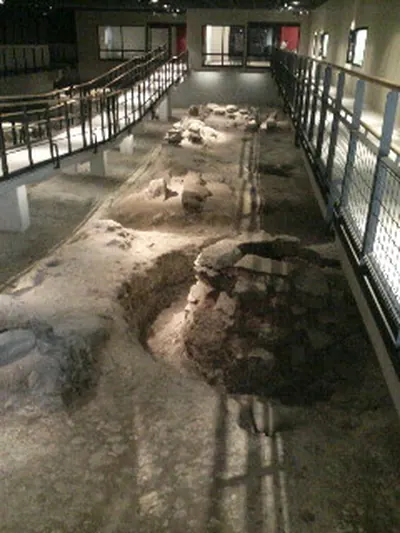
- Remains of the church’s basement.
- Iberian-style stone pavement with drainage ditches.
- Well from the Takagi family mansion.
- Excavated church roof tiles with floral crosses.
- Christian medals, crosses, rings, and rosary beads.
- Scorched plates and terracotta-colored tiles from 1663 fire.
Getting there
- Discreet doorway on side road to Nagasaki Museum of History and Culture.
In detail
This museum is tucked underneath a grand-looking primary school in the Japonesque style and accessed by a discreet doorway on the side road leading to the Nagasaki Museum of History and Culture. It is as archaeologically rewarding as it is difficult to find.
The Dominicans came to Japan from Manila in the Philippines. They built their first church at Shimokoshikijima, an island to the west of Kyushu, in 1602. They then dismantled it and moved it to Sendai on Kyushu proper in 1606. In 1609, they repeated the dismantling process, this time rebuilding it here in Nagasaki. It was made of wood with stone foundations, and was one of the very last churches to be built in the city. The 1614 edict banning Christianity also ordered the destruction of all churches, so Santo Domingo (named after the founder of the Dominican Order) had a lifespan of just five years.
The remains of the church were discovered in the late 1990s, while the school was being rebuilt. The design of the school was adapted to accommodate this museum beneath it. The first thing visible from the elevated walkway running through the site are the remains of the church’s basement. Beyond is a stretch of Iberian-style stone pavement with drainage ditches on the right. Both features date from the early seventeenth century.
The church was replaced in the seventeenth century by the mansion of the Suetsugu family, who served as daikan (local magistrates) of Nagasaki for four generations. After that, the mansion of the Takagi family, who were magistrates from the late eighteenth to the late nineteenth century, stood on this site. The well at the right of the walkway dates from when the Takagi family resided here.
At the end of the walkway is a small exhibition area. Of particular note are the excavated church roof tiles adorned with floral crosses (cross fleury). Other objects from the Santo Domingo period include Christian medals, crosses, rings, and rosary beads.
Nagasaki was ravaged by a terrible fire in 1663, and the displays include scorched plates and gray tiles turned a terracotta color by the heat. Everyday items ranging from Chinese cups and teapots to Dutch gin bottles, glasses, and plates were also found in the course of excavation.
Text: 観光庁 地域観光資源の多言語解説文データベース. Reproduced unchanged. The notes above were written from that text by Japan Gems.
Where it is
Santo Domigo Church Open in Google Maps
この施設の関係者の方へ
このページは公開情報をもとに Japan Gems が作成し、訪日外国人向けに英語で掲載しています。 写真や情報の追加・修正を承っています。お店の写真に差し替えることもできます。
このページの情報を更新する