
Aoshi Shrine
蒼柴神社
This shrine, mostly original since 1781, survived WWII and is a spiritual and social center.
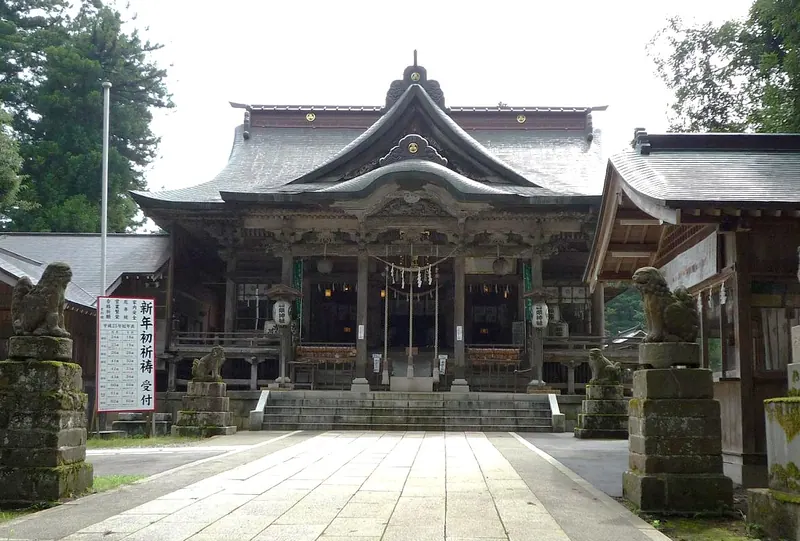
What it is
- Shrine built in 1781 by the Makino family.
- Modeled after Nikko Tosho-gu, a famous shrine.
- Survived World War II air raid devastation.
What to see
- Original appearance mostly retained for 250 years.
- Gravestones of Nagaoka domain lords behind the shrine.
- Memorial for civil war casualties nearby.
- Preserved torpedo casing at the memorial.
- Fortunes and votive tablets available.
When to go
- November 15 for Shichi-Go-San children's festival.
- April to October for weddings.
- Year-round for fortunes and votive tablets.
In detail
Aoshi Shrine has mostly retained its original appearance for almost two and a half centuries. It survived the devastation of an air raid during World War II, although many of Nagaoka’s shrines and temples were heavily damaged or destroyed. Parts of it were rebuilt after World War II.
The Makino family ordered the shrine’s construction in 1781. At that time, the family led the Nagaoka domain, centered at Nagaoka Castle in what is today the city of Nagaoka. The design of Aoshi Shrine models that of Nikko Tosho-gu, one of Japan’s most famous shrines, which is dedicated to Tokugawa Ieyasu (1543–1616), founder of the shogunate that ruled Japan for more than two centuries.
Along a path to the rear of the shrine are gravestones of the lords of the Nagaoka domain. Makino Tadanari (1581–1655) assumed control of Nagaoka Castle in 1618, and the Makino family ruled for the next twelve generations.
The final Makino to serve as daimyo was Makino Tadakatsu (1859–1918), whose reign ended in 1871 with the abolition of the feudal system and the end of the local domains. He would later go on to become a regional governor under Japan’s new system of government.
A short walk from there lies a memorial to those who gave their lives during two civil wars, the Boshin War (1868–1869) and the Seinan War (1877). A preserved torpedo casing from a Japanese submarine forms part of the memorial.
Today, the shrine plays a prominent role in a number of traditional customs. Perhaps best known is “Shichi-Go-San (“Seven-Five-Three”). This custom is observed for Japanese children around November 15 each year when families bring children of the ages 3, 5, and 7 to the shrine to pray for their future well-being, success, and happiness. Weddings take place in front of the shrine from April to October, and an array of fortunes and votive tablets are available year-round.
Shrines of this type are traditionally associated with good health and happiness. These days, however, people visit shrines seeking assistance with a variety of life issues.
Aoshi Shrine is a spiritual and social center for the people of Nagaoka. In times of joy and times of trouble, it endures as a symbol of hope, peace, and ongoing prosperity for the city.
Praying at the Shrine
Anyone can visit to offer prayers and ask the gods for help in their daily endeavors. When doing so, it is customary to approach the shrine, make an offering by tossing coins into the box, and bow twice. Then, clap your hands twice before pressing your palms together to offer a silent prayer.
Once you have said your prayer, step back and make a final bow. It is also common practice, for good luck, to ring the shrine’s bell by pulling gently on the rope that extends downward from it.
Text: 観光庁 地域観光資源の多言語解説文データベース. Reproduced unchanged. The notes above were written from that text by Japan Gems.
Where it is
新潟県長岡市悠久町707番地 Open in Google Maps
この施設の関係者の方へ
このページは公開情報をもとに Japan Gems が作成し、訪日外国人向けに英語で掲載しています。 写真や情報の追加・修正を承っています。お店の写真に差し替えることもできます。
このページの情報を更新する