
Musashi Mitake Shrine
武蔵御嶽神社
This two-thousand-year-old shrine on Mt. Mitake is a pilgrimage site for mountain training and wolf veneration.
What it is
- Pilgrimage and ascetic mountain training destination.
- Located at the peak of Mt. Mitake (929 m).
- Enshrines wolf deity Okuchimagami and Zao Gongen.
- Founded two thousand years ago.
What to see
- Treasure Hall with swords and armor.
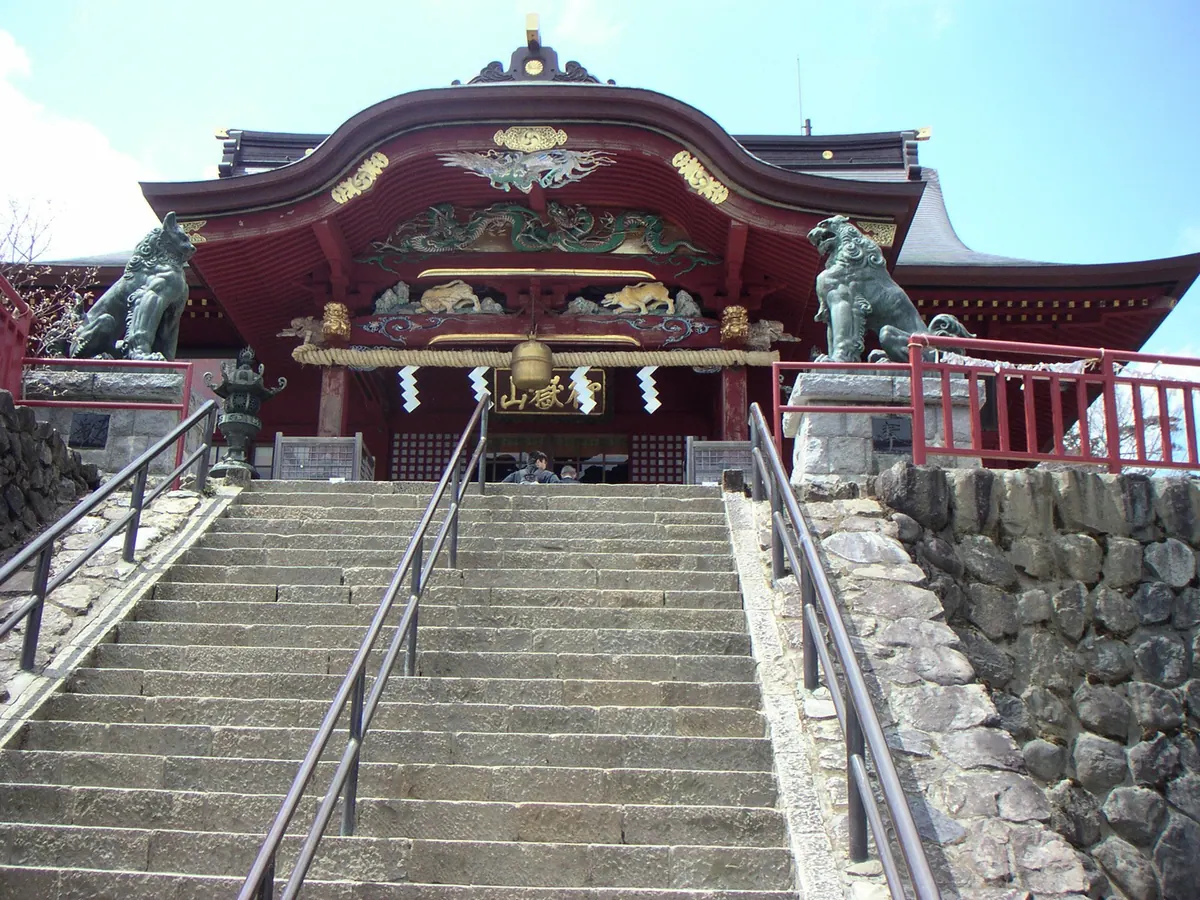
- Wolf statues guarding shrine buildings.
- Painting of the wolf legend in the worship hall.
- Daidai Kagura performance hall.
- Tokiwa Kakiwasha, a black and gilded shrine.
- Elaborately carved shrine dedicated to the wolf deity.
When to go
- Kagura performances held between June and November.
- Mountain training courses several times a year.
In detail
(Website 501-750 words)
Musashi Mitake Shrine is a destination for pilgrimage and ascetic mountain training, with a history that spans two thousand years. The shrine is located at the peak of Mt. Mitake (929 m). Okuchimagami, a wolf deity, and Zao Gongen, the principal deity of Shugendo, are enshrined here. Shugendo is a mountain religion that draws on aspects of Shinto, Buddhism, Daoism, and asceticism. The Treasure Hall on the shrine grounds houses a collection of swords and armor, many dedicated to the shrine by samurai in the twelfth and thirteenth centuries.
The legend of the wolf
Pairs of wolf statues stand guard in front of several of the shrine’s buildings. According to local lore, the legendary warrior Yamato Takeru (believed to have lived in the first century CE) was traveling over the mountains on a campaign to quell rebellious forces in eastern Japan. When he reached Mt. Mitake, his path was blocked by an evil deity in the form of a deer. The warrior struck the deer and it fled, but he was immediately engulfed by a thick fog and lost his way. A white wolf appeared and led him to safety on a mountain called Okunoin. He asked the wolf to remain as the guardian deity of the mountains, and the wolf is venerated at Musashi Mitake Shrine with the warrior. There is a large painting inside the worship hall depicting the legend.
Shugendo mountain training
A figure of the mountain deity Zao Gongen was enshrined in the main hall during the Nara period (710–794). Zao Gongen is venerated as the principal deity of Shugendo, a mountain religion that draws on Shinto, Buddhist, and Daoist beliefs. The shrine became a destination for pilgrimage and mountain training for Shugendo practitioners, who saw physical endurance as a path to enlightenment. The shrine holds mountain training courses several times a year, and visitors can experience Shugendo training on Mt. Mitake, including takigyo meditation under a waterfall, mountain running, and purification prayers.
Protecting the samurai capital
The haiden, or worship hall, has been rebuilt several times. The hall used to face south towards the samurai capital of Kamakura in Kanagawa Prefecture during the Kamakura period (1185–1333). Later, in the seventeenth century when Edo (present-day Tokyo) became the center of power for the Tokugawa shogunate, the worship hall was rebuilt and rotated 45 degrees to face east, to protect the shogun’s capital.
Kagura performances
Beside the haiden is a hall for performances of Daidai Kagura, a form of Shinto ritual dance and music. Performances tell stories of Shinto deities and are held between June and November. The shrine priests and their families have been performing Daidai Kagura for many generations. The performance is an Intangible Folk Cultural Property of Tokyo.
Exploring the shrine complex
A path from the left side of the main hall leads to several smaller shrines, dedicated to different deities. The Tokiwa Kakiwasha (built in 1511) is the largest of these, painted black with ornate gilded details. It enshrines the deities of all 47 prefectures of Japan. It served the spiritual needs of people from different parts of Japan who were living in Edo and unable to return easily to their hometowns.
At the back of the shrine complex is a small, elaborately carved shrine dedicated to Okuchimagami, the wolf deity. Wolves were once popular with farmers in the area for their role in controlling vermin, and are regarded as guardians of houses and businesses. Houses on Mt. Mitake and in the towns nearby sometimes have protective paper talismans depicting a stylized wolf displayed near the door.
Tokugawa Ieyasu, the first shogun of the Edo period (1603–1867), is enshrined in the Toshosha Shrine. The doors of the Toshosha are decorated with a pair of gilded Tokugawa crests, a circle enclosing three hollyhock leaves. Like the main hall, this shrine faces east, toward Tokyo. Next to the Toshosha, the Kofukusha Shrine enshrines the deity of good soil. Farmers who wanted to protect their crops from insects and blight would take a handful of the soil from around the shrine and sprinkle it on their fields.
Text: 観光庁 地域観光資源の多言語解説文データベース. Reproduced unchanged. The notes above were written from that text by Japan Gems.
Where it is
東京都青梅市一御岳山 Open in Google Maps
この施設の関係者の方へ
このページは公開情報をもとに Japan Gems が作成し、訪日外国人向けに英語で掲載しています。 写真や情報の追加・修正を承っています。お店の写真に差し替えることもできます。
このページの情報を更新する