
Sanko-ji Temple
三鈷寺
This temple offers scenic views of the Kyoto basin and is popular in autumn for its maple trees.
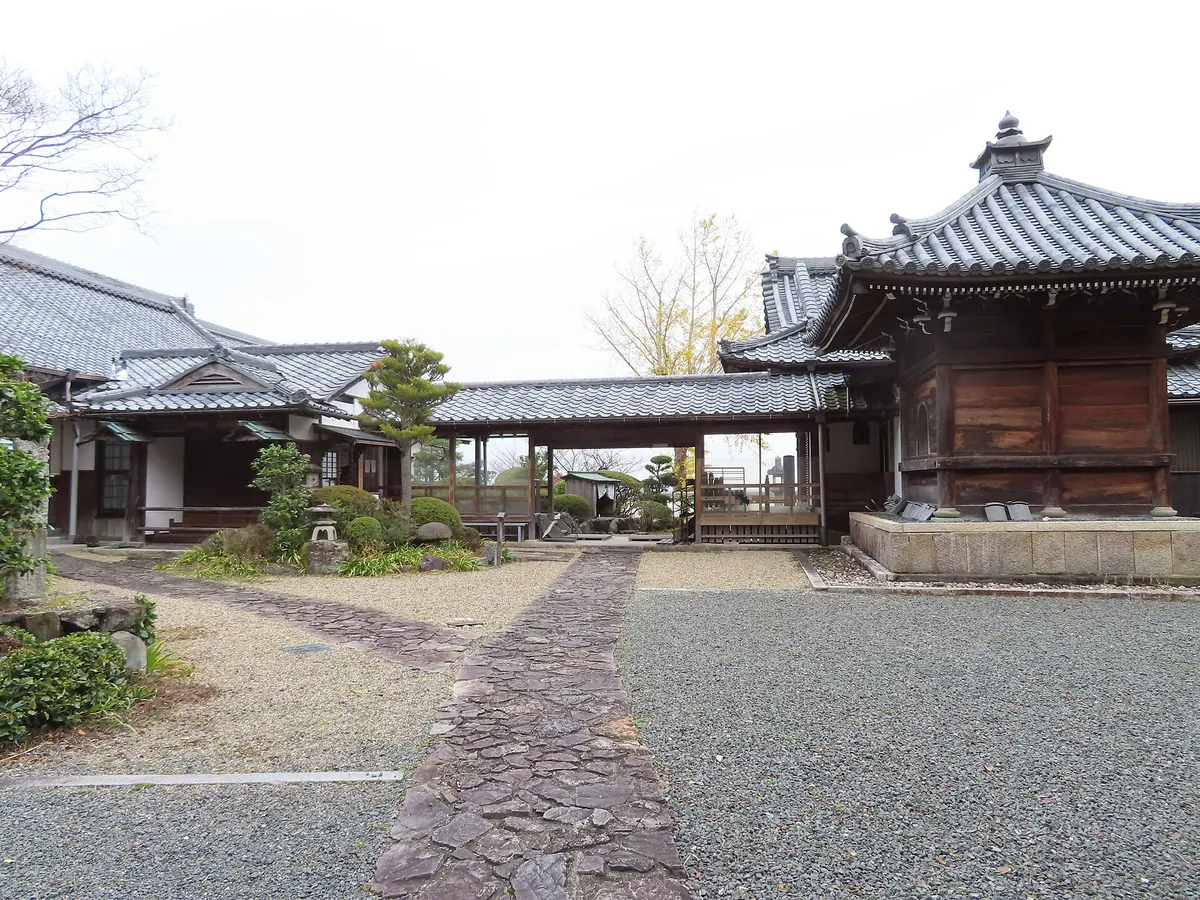
What it is
- Temple on the slope of Mt. Kamose.
- Founded in 1074 as a hermitage by Tendai monk Gensan.
- Revived in 1213 by Shoku, founder of Seizan schools of Buddhism.
- Head temple of an independent Seizan school since 1951.
What to see
- Scenic view of the Kyoto basin, Mt. Hiei, and other mountains.
- Golden statue of Fudo Myo-o in the Hondo (Main Hall).
- Statues of Amida Buddha, Prince Shotoku, Gensan, and Kukai.
- Ketaibyo Mausoleum with a statue of Shoku and memorial stone pagodas.
When to go
- Autumn, when maple trees turn red and orange.
Getting there
- Located next to Yoshiminedera Temple.
In detail
Sankoji Temple on the slope of Mt. Kamose is best known for the scenic view it commands of the Kyoto basin. The vista encompasses Mt. Hiei and the eastern Higashiyama mountains, the Kitayama mountains in the north, Kyoto itself, and the cities of Uji and Kizugawa. The temple is quite popular to visit in autumn when maple trees in the area turn red and orange. In addition, Sankoji is located next to Yoshiminedera Temple, so they can be easily enjoyed in one trip.
A Place of Many Buddhist Teachings
The temple’s origin dates to 1074, when the Tendai school monk Gensan (983–1099) built a hermitage that he named Kitao Ojoin. In 1213, Shoku (Seizan Kokushi, 1177–1247), the founder of the three Seizan schools of Buddhism, revived the hermitage as a training hall to practice nenbutsu, the continuous recitation of the name of Amida Buddha. Shoku named the temple Sankoji, as the mountains behind the temple seemed to resemble the three-pronged ritual vajra (sankosho). In 1951, Sankoji separated from the Tendai school and became the head temple of an independent Seizan school, embracing and teaching doctrines of the Tendai, Shingon, Risshu, and Jodo schools.
Hondo (Main Hall) and Its Treasures
It is difficult to enshrine the temple’s principal object of worship, the Buddha’s Eye Mandala, in the current Hondo, so a golden statue of Fudo Myo-o (the Immovable Wisdom King) presently serves as the principal image. The sculpture used to stand in front of the Buddha’s Eye Mandala before the Hondo was reconstructed in its current location. Other statues portray Amida Buddha on a pedestal with sankosho motifs, Prince Shotoku (574–622), Gensan, and Kukai (Kobo Daishi, 774–835), the founder of Shingon Buddhism. Ketaibyo Mausoleum in the right wing enshrines a statue of Shoku placed on a high pedestal that conceals memorial stone pagodas for Shoku and the poet Rensho (1178–1259), his disciple.
Text: 観光庁 地域観光資源の多言語解説文データベース. Reproduced unchanged. The notes above were written from that text by Japan Gems.
Where it is
京都府京都市西京区大原野石作町1323 Open in Google Maps
この施設の関係者の方へ
このページは公開情報をもとに Japan Gems が作成し、訪日外国人向けに英語で掲載しています。 写真や情報の追加・修正を承っています。お店の写真に差し替えることもできます。
このページの情報を更新する